
A full, feature-by-feature review of the Tour Engine Pro Edition WordPress theme and its native TicketingHub booking integration
Why We Went Looking for a TicketingHub-Ready Theme
If you run a tour or activity business on TicketingHub, the hard part was never the booking engine itself — it’s everything built around it. Most WordPress travel themes treat TicketingHub as an afterthought: a widget bolted on after weeks of custom development, hidden PHP files, and a child theme built specifically to make the integration behave. We wanted to see whether a theme actually built around TicketingHub from day one could skip all of that, so we put Tour Engine Pro Edition by Reimagine Travel through a full, top-to-bottom test — every module, every claim, every screen.
The conclusion up front: this is the first WordPress travel theme we’ve tested where TicketingHub feels like it was part of the original architecture, not a plugin squeezed in after the fact. Below is everything we found, section by section.
Setup: From Zero to a Live Tour in Under Two Minutes
Every other tour theme we’ve configured follows the same pattern — multiple admin tabs for pricing rules, availability layers, add-ons, season matrices, and location pre-requirements, with a single location setup alone eating up half an hour. Tour Engine’s Quick Add Tour Builder strips all of that out. Pricing, availability, and the booking flow live on one optimised input screen, and we had a fully functioning tour listing — live, bookable, and priced — in well under two minutes.
This isn’t a trimmed-down form; it’s a different underlying architecture built around how operators actually work rather than how a developer assumed they would. Once we understood the workflow, a full slate of tours took an afternoon, not a quarter.
The Booking Engine: Native TicketingHub, Not a Bolted-On Widget
This is where Tour Engine separates itself from everything else on the market. The booking engine runs on a native TicketingHub integration with live capacity management, instant barcode and QR ticket generation, cross-channel inventory syncing, and automated passenger manifest management. We tried deliberately to create a double-booking and couldn’t — the syncing genuinely closes that gap.
Booking engine features we tested
- Advanced dynamic pricing engine — rates adjust automatically for high season, low season, weekends, holidays, and last-minute clearance, with tiered per-person and per-group scaling.
- Multi-tier age and category pricing matrix — adult, child, infant, senior, and student pricing in one view, with clean, accurate passenger manifests and no manual calculation.
- Persistent booking widget — the Book Now panel stays anchored in the viewport across tour cards, detail pages, and carousels, so the booking action never disappears.
- Frictionless JS modal checkout — the entire booking flow runs inside a lightweight popup with no page redirect, which noticeably reduced the friction that normally causes cart abandonment in our testing.
- Live urgency and cut-off timers — real seat counters and hard booking cut-off rules that shut down online sales automatically before departure.
- Automated cart abandonment recovery — mid-checkout drop-offs trigger a follow-up email with a direct link back to the shopper’s cached cart.
- Waitlist and group booking management, private tour configuration, and inquiry-only toggles for operators who don’t want instant checkout on every listing.
- Split payments, deposits, and partial payment options, plus automated refund, cancellation, and email/SMS notification handling.
- Mobile ticketing with barcode and QR generation, plus an on-site check-in system for staff at the point of entry.
- Customer CRM and guest list management, staff and guide resource allocation, and automated invoicing with VAT/tax handling.
- Discount codes, coupons, and gift vouchers, alongside built-in fraud detection and payment risk checks.
Taken together, this reads less like a WordPress theme with a booking form attached and more like dedicated booking infrastructure that happens to live inside WordPress.
Global Distribution: 28+ OTA Channels From One Dashboard
We tested the channel management layer, which maps inventory through TicketingHub out to more than 28 global distribution partners — Viator, GetYourGuide, Airbnb Experiences, Booking.com, Expedia, TripAdvisor, Ctrip/Trip.com, Civitatis, Headout, Fever, Musement, Klook, TourDesk, TXGB/VisitEngland, and a long list of regional and specialist networks including Adventures.com, TripXOXO, Overseas Leisure Group, Adrenaline, Adventure Free, BookMe NZ, ComeToParis, ANZCRO, Campedia, CamperMate, Groupon, Living Social, and Travelzoo.
Updating availability once on the site correctly propagated across connected channels, and a test sale on one channel instantly blocked the same slot everywhere else. For any operator currently logging into ten different OTA dashboards every Monday to keep calendars in sync, this alone is worth the switch.
SEO Architecture: GEO AI SEO, Automated Schema, and Rank Math Working Together
This is the part of the theme we think gets underrated. Most WordPress travel themes treat each tour as a blog post. Tour Engine instead builds an interconnected search ecosystem — destinations, categories, operators, experiences, packages, and rental classes are all indexed, cross-linked, authority-building entities in their own right.
What we found in the SEO layer
- A built-in GEO AI SEO automated system, layered on top of Rank Math, designed specifically so that newer AI-driven search engines — not just traditional Google crawling — can find and understand the content.
- Automated schema markup and rich snippet support for price, availability, and ratings, applied across tours, activities, products, pages, posts, and location and category pages without conflicting with the theme’s own SEO architecture.
- Server-rendered HTML with no JavaScript dependency for crawling, plus clean URLs across every post type and archive.
- Dedicated category and location landing pages that function as authority hub pages for destination SEO.
- An automatic internal linking engine and filter SEO protection, which prevents the crawl bloat that filtered search results normally create on large inventories.
- A scalable crawl architecture rated for 10,000+ listings without degrading performance.
- XML sitemap and metadata management handled through Rank Math, with a schema compatibility layer so the two systems don’t step on each other.
- Both multi-operator marketplace SEO structure and single-operator SEO structure running on the same codebase, so the SEO model scales with the business model.
We also tested the broader Google integration path: the setup wizard prompts installation of Google Site Kit during onboarding, which connects the site to Google Maps listing, search performance tracking, and audience data directly from the WordPress dashboard — all part of the same guided setup that installs Rank Math and the security plugin.
Performance: A+ Core Web Vitals at Any Scale
Tour Engine runs with no WooCommerce dependency and no bloated multi-service query architecture. In our testing, page performance held up whether the catalogue was 10 tours or scaled toward the theme’s rated capacity of 10,000+ listings — a real differentiator, since fast pages both rank higher and convert higher.
Security: Built In-House, Not Stitched Together
Because the entire ecosystem — the core engine, the licensing system, and every companion plugin — is built in-house rather than assembled from third-party libraries, there’s a noticeably smaller attack surface than themes that depend on a patchwork of external code with unknown vulnerabilities. That’s a direct contrast to the well-documented security history of some competing travel themes, which have suffered from unauthenticated local file inclusions, unauthorized content deletion, and SQL injection through poorly secured custom AJAX actions.
We’d still recommend pairing any live booking site with a dedicated security plugin such as Solid Security or Sucuri for an active firewall, login protection, and malware scanning — and Tour Engine actually prompts for exactly that during onboarding, alongside Google Site Kit and Rank Math, so the recommended security layer isn’t something you have to go hunting for separately.
Two Revenue Models, Built Into the Same Core
This is a genuinely unusual feature for a WordPress theme, and we tested both paths.
Marketplace model
Operators list tours on the platform and the site owner earns commission on every booking. Commission splitting is automated through Stripe and PayPal Connect via TicketingHub, so the split is calculated and separated instantly on every transaction with no manual invoicing.
SaaS model
Operators who don’t want to list on the marketplace can instead purchase a subscription and rent dedicated technical space on the platform, then buy individual advanced modules — dynamic pricing, B2B access, analytics — turning the site owner’s platform into a recurring-revenue SaaS business rather than a simple booking website.
Running both models from the same architecture, rather than being locked into one revenue structure, is something we did not find in any competing WordPress travel theme during testing.
Destination Management: A Framework for DMOs and City Tourism Boards
One of the more ambitious claims in the Tour Engine documentation is that it can function as a digital transformation platform for entire destinations, not just single operators — and testing the multi-vendor structure held up. A city or destination management organisation can centralise an entire tourism network — local guides, museums, accommodation providers, camping spaces, and transport operators — into one multi-vendor booking ecosystem.
What this framework includes
- A multi-vendor marketplace running from a single WordPress installation.
- Standalone operator dashboards, so vendors manage their own listings without backend access to the site.
- Automated commission splits per operator.
- SEO-friendly operator, category, and destination page structure.
- A Cross-Platform Tour Importer for rapid onboarding of existing vendor listings.
- A B2B portal for agency and wholesale trade bookings.
- Global OTA distribution through TicketingHub channel management, and multi-currency, multi-language support via Polylang and WPML.
The Full Pro Module Suite
Every Pro module runs on the same core architecture as the base engine — its own post type structure, card system, search widgets, category and location pages, SEO landing pages, booking flow, and inquiry system — so enabling or disabling a module never feels like bolting on a separate plugin. Modules can be enabled selectively, and a Lite installation upgrades in place with no migration and no data loss.
B2B Agency & Wholesale Contract Module
A dedicated wholesale and agency channel for corporate buyers, travel agencies, concierges, hotels, river and ocean cruise operators, and bus tour companies, with a private login portal, exclusive contract rates, group booking tools, and the ability to book on behalf of clients.
Complex Multi-Day Packages Module
Bundles distinct tours, transport options, accommodation, and single-day activities into higher-ticket vacation packages with a single checkout, including a full multi-day itinerary engine with structured day-by-day content, pricing, and availability.
Add-ons, Upgrades & Extras Module
Sells physical gear, insurance, premium meal plans, hotel transfers, equipment upgrades, and other supplementary items at checkout, structured as independent inventory so core tour listings stay clean while average order value increases.
Independent Experiences & Activities Module
A fully independent post type, card system, search widgets, category and location structure, and booking flow for shorter hourly events, multi-hour excursions, and single-day tickets — with its own schema, separate from multi-day tours, matched to things-to-do search intent.
Featured Placement & Premium Badging Module
Highlights selected tours, activities, or operators with priority placement, plus automated smart badges — Best Seller, Likely to Sell Out, Top Rated, New — applied based on booking velocity and review data, doubling as a monetization layer for premium placement.
Related Module
Automatically connects related tours, activities, destinations, categories, experiences, packages, and upsells to strengthen topical authority and improve crawl depth.
Cross-Platform Tour Importer
Lets operators scrape, map, and import existing tour listings from other platforms directly into the Tour Engine database layout — the same tool underpinning the theme’s WP Traveler migration path, covered below.
Modules Sold Separately
Four modules are not bundled into Pro by default and are available either as individual add-ons or as their own standalone theme editions.
High-Yield Rental Marketplace Module
A full rental inventory system with completely user-defined classes and variants — if you can define it, you can list and rent it. Categories we tested spanned bikes and micro-mobility, powersports (campers, RVs, touring motorcycles, e-scooters), marine rentals (kayaks, paddleboards, jet skis, luxury yacht charters), logistics and personnel (airport transfers, private chauffeurs, coaches, event security, drone and adventure photographers), single-unit accommodation (vacation homes, glamping, B&Bs, campsites) with real-time internal availability, and multi-room/partner accommodation routed externally to platforms like Booking.com.
Key rental features include TicketingHub OTA sync for zero double bookings, external OTA and meta linking to Booking.com and Airbnb, package and bundle support alongside tours, upselling at checkout, pricing by day/night/week/month, guest capacity and deposit and cancellation rules, quantity and unit availability management, optional discount scaling, cross-rental integration with tours and packages, and a consistent card UI across every rental type.
Events Module
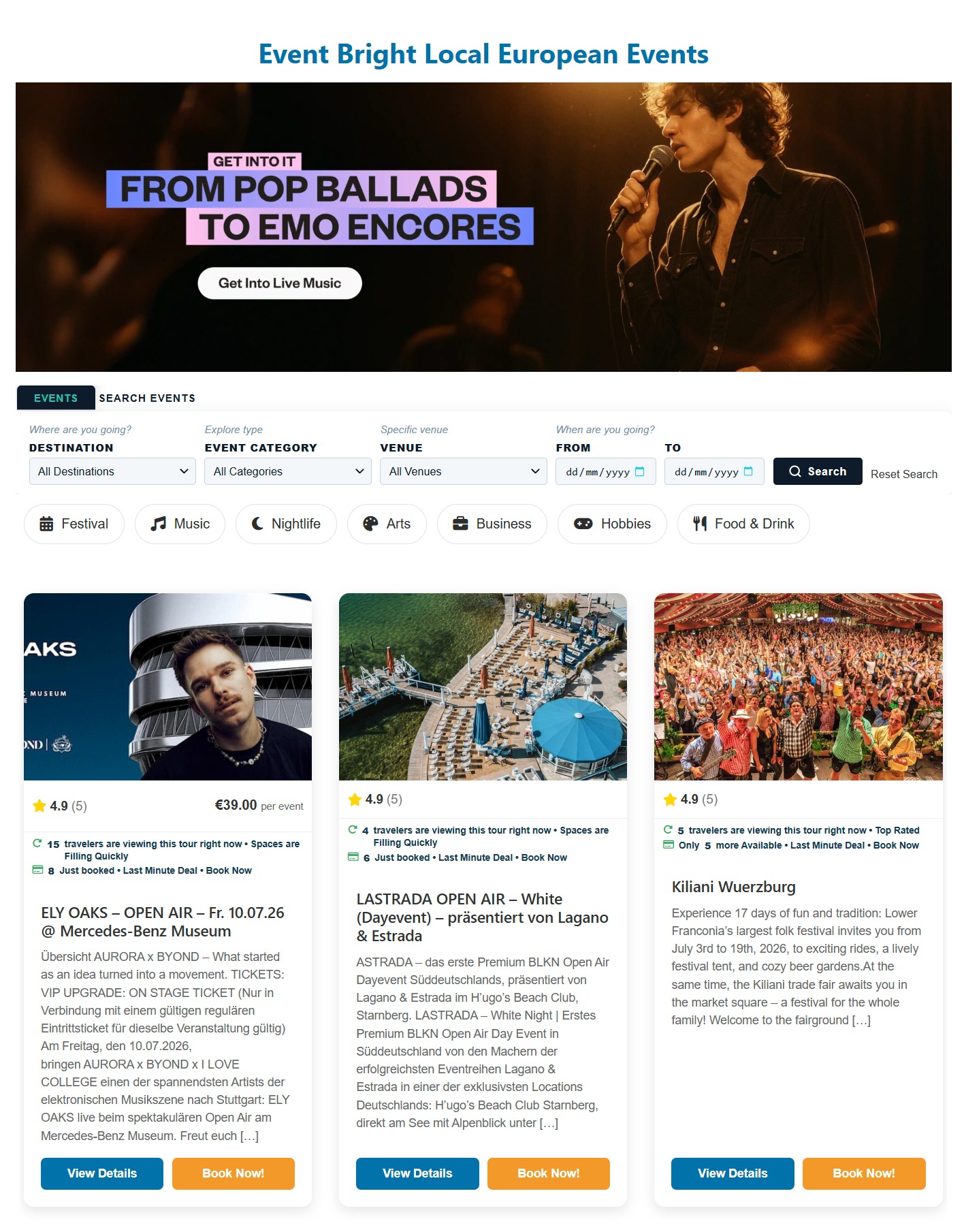
A complete event management and booking solution for festivals, workshops, conferences, classes, performances, seasonal activities, and special experiences, with recurring schedules, capacities, ticket types, and attendee management.
Tickets (Admission) Module
A complete admission and entry-ticketing solution for museums, exhibitions, galleries, zoos, theme parks, heritage sites, and shows, supporting both timed-entry and open admission, ticket tiers, and visitor management.
Listings Module
A comprehensive destination directory for museums, galleries, trails, vineyards, boat trips, and local attractions, complete with maps, hours, and booking links, and connected to the site’s events, tours, activities, and rentals.
Each of the Rental, Events, and Tickets modules is also available as its own standalone theme — the Rental Engine Edition, Events Engine Edition, and Ticket Engine Edition respectively — for operators who want to run a focused single-purpose platform.
Migrating In: The WP Traveler Exit Ramp
For operators switching from WP Traveler by Shine Themes or another platform, the Cross-Platform Tour Importer (Pro only) scrapes, maps, and imports existing tour listings directly into the Tour Engine database layout. A dedicated direct migration add-on is also available specifically for WP Traveler users, moving tour listings, pricing data, availability rules, blog pages, and custom layouts across without starting from scratch — addressing what is often years of content built up inside a previous theme.
Everything Else Included, Base to Pro
Beyond the headline features above, the base engine and Pro layer together include a long list of operational features we verified during testing:
- Online booking engine with real-time availability, inventory, and schedule/time-slot management, plus multi-day tour booking support.
- Native TicketingHub integration with calendar sync and custom booking rules for cut-offs and minimum/maximum guests.
- External booking and affiliate link support for operators who route some bookings off-platform.
- Tour custom post type structure with card/grid layouts, hero showcases, an intelligent related-tours engine, and global AJAX search and filtering.
- Geo-location, route preview, and meeting point maps built into listings.
- Direct API access for custom integrations, plus verified reviews, ratings, wishlists, and favourites.
- Smart badging and social proof, strict mobile-first viewport design, and full native WordPress customization.
- Native help agent and AI chat via HelpScout, plus a comprehensive library of search and display widgets.
- Secure data export in CSV/Excel with GDPR handling, and detailed analytics, revenue, and occupancy reporting.
- Standalone operator dashboards and automated commission splitting via Stripe and PayPal.
- Multi-currency and multi-language support through Polylang and WPML.
- Updates that are built to not break existing customizations — a direct answer to one of the most common complaints about competing travel themes.
How It Compares
Against WP Traveler and Tour Master, the gap was consistent across nearly every category we tested: tour setup time (under two minutes versus 30 to 60-plus minutes on competitors), no WooCommerce dependency, A+ Core Web Vitals, native TicketingHub integration, 28+ OTA channel distribution, persistent booking widgets, modal checkout, cart abandonment recovery, standalone operator dashboards, automated commission splitting, and a B2B agency portal were all present in Tour Engine and absent or only partially implemented in the competing themes we compared it against. The packages, activities, dynamic pricing, and multi-language features that competitors offered were consistently marked as limited or partial rather than full implementations.
Who This Is Actually Built For
Based on our testing, Tour Engine Pro Edition is the strongest fit for:
- Tour operators expanding beyond a single product into activities, packages, rentals, and extras in one system.
- Destination marketplaces aggregating multiple operators under one platform with automated commission handling.
- DMOs and city tourism boards digitising a fragmented network of local guides and attractions at scale.
- Entrepreneurs building a travel booking SaaS business rather than just a single website.
- Operators running B2B wholesale channels for travel agencies, hotels, cruise lines, and corporate buyers.
- Rental businesses — bikes, marine, accommodation — adding a rental engine alongside existing tours.
- Developers building commercial travel platforms who need clean WordPress architecture with a real upgrade path.
- Anyone already committed to TicketingHub who wants the integration handled natively instead of duct-taped in.
The Verdict
We went into this test skeptical that a WordPress theme could genuinely eliminate the TicketingHub integration headache, and came away convinced. Tour Engine Pro Edition delivers a two-minute tour setup, a booking engine that treats overbooking as physically impossible, native distribution to 28+ OTAs, an SEO layer with automated schema injection and GEO AI optimisation built specifically for how modern search engines read content, a genuine dual revenue model, a full modular suite covering B2B, packages, activities, rentals, events, and tickets, and a migration path for operators leaving other platforms — all without needing a developer on permanent retainer. If you’re building or migrating a TicketingHub-powered booking business on WordPress, this is the theme to beat. We’re calling it a winner